On Friday, 28 August 1964, Slatington's week-long centennial celebration was reaching its end. On a sunny, low 80-degree day, upper Main Street had been roped off for a block party. Now I was too little to remember that celebration, but when Slatington again blocked off upper Main Street to celebrate the sesquicentennial in 1989, my friends and I stood on Main Street under the traffic light drinking some beer.
That Friday evening in 1964, the centennial homecoming dinner was held in the gym of the Slatington High School. (That building is now the Northern Lehigh Middle School.) Almost six hundred people packed the gym. When dinner finished, festivities moved into the auditorium which was completely filled. There was a program of speeches, recollections about the town's history and several musical selections. "In between the speakers there was the local talent" that performed. (The Slatington News, 3 September 1964)
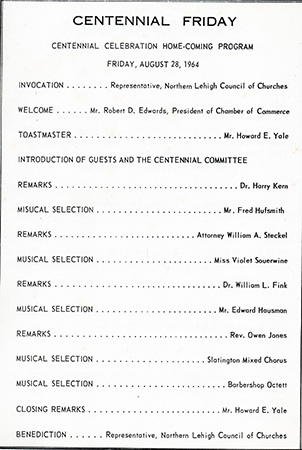
Slatington centennial program
"Fred Hufsmith, who went to high school in the borough and was a radio star many years ago before retiring and settling in Yonkers, NY, sang the beautiful 'Serenade' and the nostalgic 'Hills of Home'." (The Morning Call, 29 August 1964) Have a listen to Mario Lanza singing the 'Hills of Home'.
Edward Hausman, "concert pianist and professor of music at Skidmore College in New York, formerly of town, played several solo numbers and accompanied the vocalists on the program." (The Slatington News, 3 September 1964)
So, who were these two, distinguished musicians, Hufsmith and Hausman, both from Slatington, who were performing again in Slatington in August 1964?

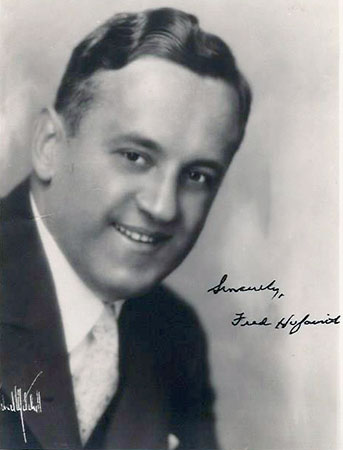
Fred Hufsmith; photo credit
Fred Hufsmith, one of the leading tenor singers of the country in the early twentieth century, was born in 1897 in Bethlehem, PA, just about fifteen miles down the Lehigh River from Slatington. Around 1903, the family moved to 315 Williams St. in Slatington. Edwin Hufsmith, the father, was employed in the silk mill industry, and he had taken a job as foreman of the Post & Sheldon silk mill in lower Slatington between Cherry St. and Horlacher Alley.
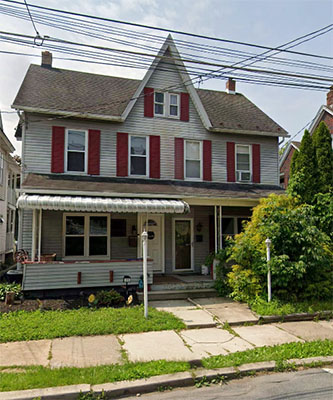
315 Williams St., Slatington, PA; photo credit: Google Street View
Including Fred, there were six in the Hufsmith family.
- (father) Edwin Franklin Hufsmith (1870-1939), born Chestnuthill Twp., Monroe County, Pennsylvania. He died in Miami, FL, where he had moved about 1925 to help his son-in-law operate the Miami Laundry.
- (mother) Caroline (Carrie) Nauman (1872-1960), born and raised in Bethlehem, PA. She married Edwin in 1893.
- (sister) Hilda Ellen Hufsmith (1893-1961) was born in Bethlehem, PA. In 1916, she married George Morris Morgan (1889-1945). They owned and operated the Miami Laundry in Miami, FL.
- (sister) Mary Katherine Hufsmith (1904-1952) was born in Slatington. In 1926, she married David D. Frederick (1904-1970). He was in the laundry repair business. They lived in Allentown, PA.
- (brother) Rollin Edwin Hufsmith (1907-1970) was born in Slatington. In 1929 in Iowa, he married Maxine Oliver (1910-1999). They moved to Miami where Rollin worked in the Miami Laundry.
By 1912, Hufsmith was a freshman in Slatington High School, but I could not find any record to indicate that he actually graduated. That was not unusual at the time as while 47 boys and girls had started high school as freshmen in 1912, only 27 actually graduated in 1916.
At some point around 1915 Hufsmith briefly worked for The Slatington News, the town's weekly newspaper.
His singing career began in Slatington.
In March 1915, he performed in an annual minstrel production organized by the town's Premiere Musical Association, which was active in the first few decades of the twentieth century. Performances were often held in the old Opera House, later known as the Arcadia Theater, on East Church Street. That theater burned down in 1969. Hufsmith sang as part of the ensemble, and he had one solo number.
The following year the annual minstrel show was held in the Band Hall (later the site of Smith Hall and now a parking lot for the George Dillard Manor) in celebration of the 3rd anniversary of the Premiere Musical Association. Hufsmith sang a tenor duet with Thomas Hunt, which was noted by a reporter as "one of great merit." (The Slatington News and The Morning Call, 11 February 1916)
Over the next few years, Hufsmith sang frequently for many of the town's churches, organizations and special events. Here are just a few examples.
- 19 November 1916, special anniversary service at the Trinity United Evangelical Church (now the Trinity Evangelical Congregational Church) on Second Street. (The Slatington News, 24 November 1916)
- 16 January 1917, concert in St John's Lutheran Church on Second Street.
- 27 April 1917, concert in the Band Hall as part of the celebration of the 46th anniversary of Slatington Lodge No. 294 of the Knights of Pythias.
- 28 August 1917, a Premiere Musical Association minstrel show as part of the 6th annual Handwerk family reunion. Hufsmith sang "All the World Will Be Jealous of Me," a popular 1917 song with lyrics by Al Dubin and music by Ernest Ball. (Here's an example.)
- 17 December 1917, performance for the good fellowship class of St. John's Reformed Church on Second Street
- 24 February 1918, Salvation Army war service rally in the Opera House.
- 19 March 1918, Red Cross benefit operetta, The Rivals, performed in the Opera House.
- 7 May 1918, Slatington community orchestra benefit concert held in the auditorium of the old high school which used to stand on Main Street.
- 19 July 1918, Premiere Musical Association program in the high school auditorium. Fred Hufsmith sang "God Be with Our Boys Tonight" (a popular 1918 song written by Fred Bowels and Wilfrid Sanderson).
- 1 December 1918, an evening song service for the 23rd anniversary of the Trinity United Evangelical Church.
- 8 August 1919, the welcome home banquet and celebratory program for soldiers given by Washington Camp No. 119 of the Patriotic Order Sons of America.
- 1 September 1919, Premier Musical Association picnic and carnival on Labor Day
- 12 September 1919, a grand musical in the high school auditorium, organized by the men's bible class of the Trinity United Evangelical Church.
In June 1918, Hufsmith reported for his draft registration, and in that year's draft lottery, he was assigned the number 78, which meant that he was almost certain to be drafted. On his draft registration card, he identified himself as of medium height, medium build, brown hair and gray eyes. Hufsmith was indeed drafted, and in mid-August 1918, he was sent to Camp Lee in Virginia. About a month later, The Allentown Democrat newspaper reported that "Fred Hufsmith, Earl Brown and Thomas Hankey who were sent to Camp Lee on 26 Aug, returned home on Thursday being disqualified for military service." No further reason was provided. (The Allentown Democrat, 10 September 1918)
Bethlehem, PA
In October 1919, Hufsmith moved to Bethlehem, PA where he lived for a few years. According to The Slatington News (31 October 1919), "Fred Hufsmith has resigned his position with Huff Music Co. [then located at 632 Main Street, now the site of Master's barbershop] and accepted a position in the Safety and Welfare Dept. of the Bethlehem Steel Co. He also accepted a position as tenor soloist with the Nativity Church choir of Bethlehem." The 1920 census confirmed that he was living in Bethlehem and employed as an office clerk at Bethlehem Steel.
We do not have a lot of information about Hufsmith's activities while he was living in Bethlehem, but it is pretty clear that he was active in the area as a soloist. There were many notices in the newspapers of his singing at different events.
- May 1921, with the Premiere Musical Association in Slatington to benefit the four-county fireman's convention
- November 1921, at the Salem Lutheran Church in Bethlehem
- July 1922, with the Colonial Operatic Company at the Palmerton Chautauqua festival. "Mr. Hufsmith who is rapidly making a place for himself in the singing world." (The Slatington News, 14 July 1922)
Then, in April 1922, he signed a contract with a Chautauqua company to tour the United States. (The Morning Call, 5 April 1922)
Chautauqua and Philadelphia, PA
In the first months of 1923, Hufsmith was singing with the Swarthmore Chautauqua Company. (The Slatington News, 12 January 1923; The Morning Call, 21 May 1923)
The Chautauqua movement began in the late 1800s in upstate New York and gradually spread across the country. It was an educational/cultural movement that featured self-improvement lectures, poetry readings, dramatic presentations, musical performances and speeches.
By the 1920s in a community like Slatington, the citizens could get together and organize a few days' worth of activities during one week of the summer. It was more common, however, for a community to hire one of the many touring Chautauqua companies to come to a town, set up and put on all the activities.
The Swarthmore Chautauqua, with which Hufsmith found some employment, had been founded in 1912 at Swarthmore College in the far western suburbs of Philadelphia. Its activities peaked in the early 1920s, and it had ceased operation by about 1930.
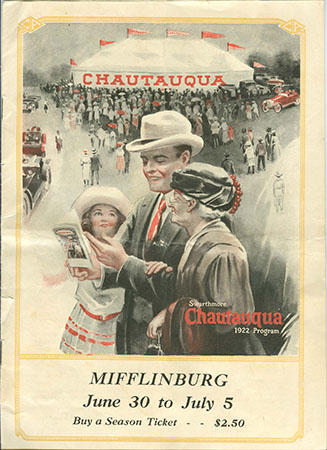
Example of a Swarthmore Chautauqua program from 1922; photo credit
While in Philadelphia, Hufsmith also sang with the Conley Concert Company of Philadelphia. This was a collection of performing artists organized under the direction of Frank M. Conly (1876-1941), who was a well-known opera, radio, concert and recording artist and church choir director. The Conly Concert Company, which had been founded in 1918, performed throughout Pennsylvania, New Jersey and Delaware in the 1920s.
In November 1924, the company performed a program of twelve numbers in the Slatington High School auditorium. The publicity blurb had this to say about Fred Hufsmith: "a brilliant young singer, 25 years of age, whose success in concert and oratorio during the past 2 years has been nothing short of phenomenal." (The Slatington News, 7 November 1924)
At about this time, Hufsmith was also part of a vocal group conducted by Henry Gordon Thunder Jr (1868-1958) of Philadelphia (The Morning Call, 2 October 1924) Thunder was a noted pianist, conductor and organist who was associated with several different Philadelphia churches in the twentieth century. He was also, at one time, the conductor of an orchestra that later became the nucleus for the world-renowned Philadelphia Orchestra. Thunder also conducted the Philadelphia Choral Society for thirty years.
Singing in various Philadelphia churches and with the Swarthmore Chautauqua, the Conley Company and Henry Gordon Thunder provided Hufsmith with a fine introduction to the Philadelphia music scene.
Although living and performing in Philadelphia, Hufsmith still returned to Slatington for concerts many times in the 1920s. Here are just a few examples.
- Sang in the 2nd annual musical program of the Trinity United Evangelical Church on Tuesday evening, 30 December 1924 (The Slatington News, 26 December 1925)
- Entertained with the American Legion minstrels after a ladies' auxiliary supper in the legion home on Thursday evening, 21 May 1925 (The Morning Call, 14 May 1925)
- Performed with the Slatington Band on Thursday evening, 20 August 1925 at Victory Park (The Slatington News, 14 August 1925)
- Sang in the 3rd annual musicale program of the Trinity United Evangelical Church on Tuesday evening, 5 January 1926 (The Slatington News, 1 January 1926, and The Morning Call, 7 January 1926)
While in Philadelphia, Hufsmith was also introduced to broadcast radio. The first notice of his appearing in a radio broadcast comes from the listing of Philadelphia radio broadcasts that appeared in The Philadelphia Inquirer on Wednesday, 19 May 1926. He was scheduled to sing that evening on a 30-minute show on station WLIT which was an early AM radio station associated with the Philadelphia-based Lit Brothers Department Store, located at Market and N. 8th Streets. The station had begun broadcasting in 1922 and continues to this day under the call sign WFIL
In the "Radio Program" listings from The Morning Call on Saturday, 1 October 1927, Hufsmith was listed to perform on a thirty-minute program called Morning Sip Coffee under the direction of Frank Conly. The radio program included a pianist, soprano, contralto, baritone and Hufsmith as tenor. This program was broadcast by another Philadelphia station, WIP, which had begun broadcasting in 1922 from a studio above the Gimbels Department Store at 9th and Market Streets in Philadelphia. This was also an early AM radio station, and the station kind of continues to exist today at WTEL.
Miami, FL
In December 1925, the Hufsmith family moved from Slatington to Miami to take up jobs in the laundry business run by Fred's brother-in-law. Fred would often spend time in Miami during the winter.
In November 1927, he was off to Miami where he had been offered a scholarship to the Conservatory of Music connected with the University of Miami. (The Slatington News, 4 November 1927) For most of 1928 and 1929, he was performing in and around Miami as part of his studies at the university. Even when he later moved to New York, he retained many Miami connections.
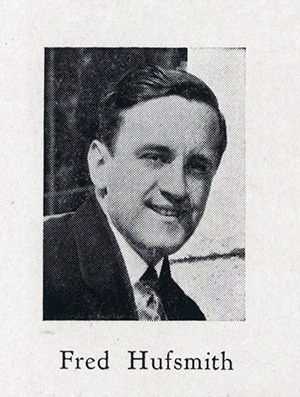
Photo Credit: University of Miami Ibis Yearbook, 1927
At the university, Hufsmith routinely sang in the university quartet and the university trio and was often accompanied by the university symphony orchestra.
- Wednesday evening, 15 February 1928, "Accompanied by the University of Miami Artists Trio, Hufsmith sang several arias including "Il Mio Tesoro" from Mozart's opera Don Giovanni." (University News, 23 February 1928)
- The University Quartet on Sunday, 15 April 1928, "performed with the University of Miami Symphony Orchestra at the Ida M. Fisher School Auditorium," singing the quartet from the opera Rigoletto and the sextet from opera Lucia di Lammermoor. (University News, 16 April 1928)
By late 1929, Hufsmith was off to make his debut in New York, and while New York would become his home, he continued to appear in Miami through the early 1930s.
- Sang as a guest artist at the symphony concert on Thursday, 19 January 1930 in the Miami High School auditorium. He was scheduled to sing several popular arias. The school newspaper noted that "Hufsmith, during the past two years, has carved a place for himself in the musical annals of the nation. He is ranked among the leading lyric tenor singers of the country" (The Miami Hurricane, 16 January 1930)
- "Radio Singers Get Applause at Music Club." Fred Hufsmith and Muriel Wilson, later his fiancée, did a joint recital for the Mana-Zucca Music club in Mazica Hall. They opened the lengthy program by singing a duet from Verdi's opera La Traviata and finished the program with a duet from Victor Herbert's "Madcap Duchess." (The Miami News, 20 February 1935)
Let me just note here that Mazica Hall was once the home of Mana-Zucca (1885-1981). She was a renowned concert pianist and a prolific, and popular, composer of the early and mid-twentieth century. The stucco hall on 17th Street in Miami is no longer in existence.
New York City
One week Fred Hufsmith was singing in the Arcadia Theatre on East Church St. in Slatington, and a few weeks later he was singing in the Hotel Barbizon on East 63rd St. in New York City.
"Hufsmith Concert Thrills Audience" in Slatington. "Those fortunate enough to attend the concert … in the Arcadia Theatre, last Friday evening, received more than a treat … They heard one of the best and pleasing musical programs presented in this section." (The Slatington News, 24 October 1929)
Soon after that concert, Hufsmith was off to New York to prepare for his debut on Sunday afternoon, 1 December 1929, as part of the Barbizon New American Artists Series. An expert panel had "selected [him] from several hundred singers" who had appeared in lengthy auditions. According to the Miami Hurricane newspaper, his program was scheduled to include an operatic aria from Don Giovanni, a group of German songs and a selection of English songs." (The Slatington News, 28 November 1929; Miami Hurricane, 26 November 1929)
The Hotel Barbizon, the site of Hufsmith's debut, had just opened in 1927 as a women's hotel, but it was also a noted artistic center in the late 1920s because of the many music recitals that were carried out there. The hotel still exists as Barbizon 63 at 140 East 63rd Street in New York.
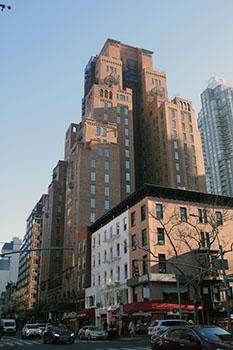
The former Barbizon hotel; photo credit “epicgenius” at Wikipedia
The New York Times covered the recital with the headline, "F. HUFSMITH'S RECITAL; Young Tenor Makes New York Concert Debut at the Barbizon."
"Frederick Hufsmith, a young tenor who is a soloist at the Fourth Presbyterian Church and has also gained experience as a member of traveling opera companies, made his New York recital debut yesterday afternoon at the Hotel Barbizon. His resonant and well-schooled voice was heard to advantage in Ottavio's aria, "Il Mio Tesoro," from Mozart's Don Giovanni and in a group of songs by Richard Strauss, Schubert, Weingartner, Bridge, Arnold Volpe and Mana-Zucca." (The New York Times, 2 December 1929, Section Social News, Page 23)
Early singing career in New York City
In the years immediately following his debut in New York, Hufsmith was appearing on a variety of radio programs in New York, and he was also still showing up occasionally in Slatington and Miami for performances.
For example, he was a guest soloist in a program given by the Knights of Pythias male chorus of Slatington at Allentown High School on 29 May 1930. "The concert was one of the finest given locally this season," noted The Morning Call, and Hufsmith was a "sweet-voiced tenor of exceptional ability." (The Slatington News, 22 May 1930; The Morning Call, 30 May 1930)
Then in January 1931, he performed at the Hotel Everglades in Miami, and then a few days later he sang with the University of Miami concert orchestra in an outdoor concert at Bayfront Park in Miami. (The Miami News, 25 January 1931; The Miami Herald, 28 January 1931)
At this time, he was also a soloist of the Fourth Presbyterian Church in New York City.
In the 1930s, newspapers were filled with radio program listings, much like decades later newspapers published daily television listings. Most of the radio programs were 15, 30, 45 or 60 minutes long, and everything was done live.
Below is an example of radio listings from The Brooklyn Daily Times, 15 March 1931. These listings are quite extensive because there were a lot of radio stations in the New York City area. But papers across the United States all carried similar radio listings.
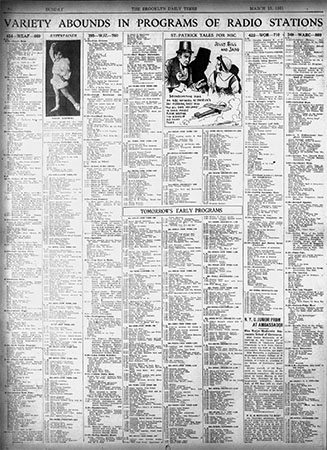
Hufsmith appeared on many different types of radio programs and at different days and times of the week. Here are just a few examples:
- In October 1930, Hufsmith sang every morning on a short program "Morning Devotions" from 815 to 830 on radio station WEAF. (The Slatington News, 30 October 1930)
- In December 1931, "The charms and grace of another day were recaptured by Fred Hufsmith, tenor, in his singing of 'Beautiful Lady' on WEAF's Musical Magazine Tuesday evening at 9 o'clock." (Daily News, 9 December 1931)
- In July 1932, Hufsmith sang on a program called "Vocal Arts Quarter" on WEAF with Carol Deis (soprano), Alma Mitchell (contralto), and Aiden Edkins (baritone). (Times Union, 18 July 1932)
While on vacation in Miami, Hufsmith spoke about his preference for formal attire while singing on the radio. "Evening clothes may not make the artist, but they do add a lot of the artist's feeling of spiffiness when broadcasting." He went on to speak of the formality of the "Westinghouse Salute" concerts on Wednesday evenings. These were staged with a full 50-piece orchestra that was sponsored by the Westinghouse Electric Company at great expense. (Miami Daily News, 26 January 1930)
The 100th anniversary of the death of Johann Wolfgang von Goethe, the German poet, philosophe and novelist of the eighteenth century, was the reason for a special NBC performance in 1932. Clarence J. Ingram (1892-1956), who wrote a column about radio happenings under the pseudonym the "One Dialer" for The Jersey Journal, covered the special event, which took place in the studio of noted organist Archer Gibson (1875-1952). The performance took place at 1130 PM Tuesday night, 22 March 1932, and lasted sixty minutes.
Ingram arrived during the final rehearsal, five minutes before air time, and noted that a rehearsal always took place before a broadcast. Gibson was at his organ console, and the announcer, Milton Cross (1897-1975, most famously known as the voice of the Metropolitan Opera Saturday afternoon broadcasts), marked time as he prepared to introduce the broadcast.
We also have a list of the performers who crowded into the studio with Hufsmith that Tuesday night. Most of these singers were very prominent on the radio airwaves during the 1930s.
- Amy Goldsmith, soprano
- Elizabeth Lennox, contralto
- Theodore Webb, baritone
- Oswaldo Mazzuchi, cello
- Florence Wightman, harp
- Plus, there was a pianist and a radio production man.
Hufsmith performed:
- Jules Massenet's "Claire de Lune" from the opera Werther in a duet with Amy Goldsmith (Here's an example.)
- Excerpts from Charles Gounod's Faust, also sung in a duet with Goldsmith.
As final arrangements were being made for the broadcast, there was "an air of tenseness. Yet an all-pervading calm was sensed." "What a glorious hour it was. If you were unfortunate enough to have missed it, nothing we are capable of writing would even remotely convey an idea of those tone laden 60 minutes." (Last Night with the "One Dialer," 24 March 1932, The Jersey Journal; 22 March 1932, Brooklyn Eagle) That's an appropriate quote of trying to convey the magic of radio's golden age in the 1930s.
Hufsmith also participated in the debut of Radio City Music Hall.
The New York Times wrote:
"Five hundred persons on the stage of the Radio City Music Hall yesterday noon sang and played to a hardly visible handful of some 300 others scattered among the new sunburst theatre's 6,000 chairs. Uncounted listeners-in were at the same hour hearing every note of the same music in the first world-wide broadcast from Radio City."
Hufsmith was one of the six soloists in the hour-long oratorio - an oratorio is similar to an opera but there is no acting, just singing - titled "Voice of Millions" (The Philadelphia Inquirer, 18 December 1932; The New York Times, 26 December 1932) The oratorio was written by Dezso D'Antalffy (1885-1945), a Hungarian organist and composer, and Erno Rapee (1891-1945), a virtuoso pianist and later conductor of the Radio City Symphony Orchestra. Included among the performers were the Tuskegee Negro Choir, the Radio City Music Hall Choir, a select children's chorus and the Radio City orchestra. One can only imagine the chaos on the crowded stage as the broadcast proceeded.
The Christmas oratorio was the first radio broadcast from Radio City Music Hall, which formally opened to the public two days later on 27 December 1932.
Sometime in 1932, Hufsmith formally signed a contract with the National Broadcasting Company (NBC). (The Slatington News, 6 October 1932)
The signing was also noted by The Morning Call, "Fred Hufsmith, of Slatington, Now Exclusive N.B.C. Artist - Has Appeared on Many Important Advertising Programs – Sang in Lohengrin, Directed by Dr. Walter Damrosch." "The meteoric rise of a Lehigh County boy in the radio world, is winning wide acclaim among his legion of friends in this section." After a varied career stretching from Slatington through Philadelphia and then to Miami and New York, he is "now under the exclusive management of the National Broadcasting Co." "He has appeared on programs such as "Listerine, General Motors, McKesson & Robbins, Hoffman Hour, Elgin Watch and the Coca Cola and other commercial presentations." "Possessed with a remarkably sweet lyric tenor voice, he has made a decided hit with radio fans." (The Morning Call, 31 July 1932)
The Golden Age of Radio in the 1930s
Commercial radio broadcasting began in the United States in the early 1920s, reaching its peak in the 1930s and 1940s. That's a period of time often called the golden age of radio, or the old-time radio era. It was a time when "83% of American homes owned a radio" (Wikipedia) and "the medium of commercial broadcast radio grew into the fabric of daily life in the United States." (Britannica)
Radio programs were usually offered in 15, 30, 45, or 60-minute increments, and they could be soap operas like "The Guiding Light," science fiction like "Flash Gordon," crime drama like "The Shadow," westerns like "The Lone Ranger," game shows like "What's My Name?" or comedy like "Abbott and Costello." There were also many news programs along with coverage of live events, like sports contests and musical concerts.
Musical programs of all types were popular. Classical, opera, pop, swing, jazz and variety shows all found a place on the radio airwaves. And everything on the radio was done live, which means that it took an army of performers to fill all that air time on the radio.
The National Broadcasting Company (NBC) was founded by RCA as a commercial radio network in 1927. Within a few years, WJZ and WEAF became the two major NBC radio stations in New York - Fred Hufsmith sang at both of them. The stations had slightly different focuses, and each station became the flagship for a linked network of NBC stations across the country.
WJZ – "blue network," which much later became ABC.
WEAF – "red network"
Both stations in New York shared many common facilities, studios, engineers and performers. A studio could become extremely crowded during a broadcast depending on how many performers were involved in the production and the actual size of the studio.
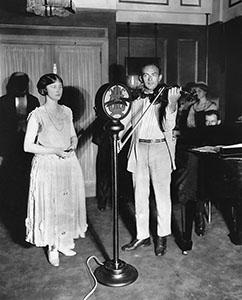
“Another view of the WJZ studio at Aeolian Hall in New York, about 1924”; photo credit
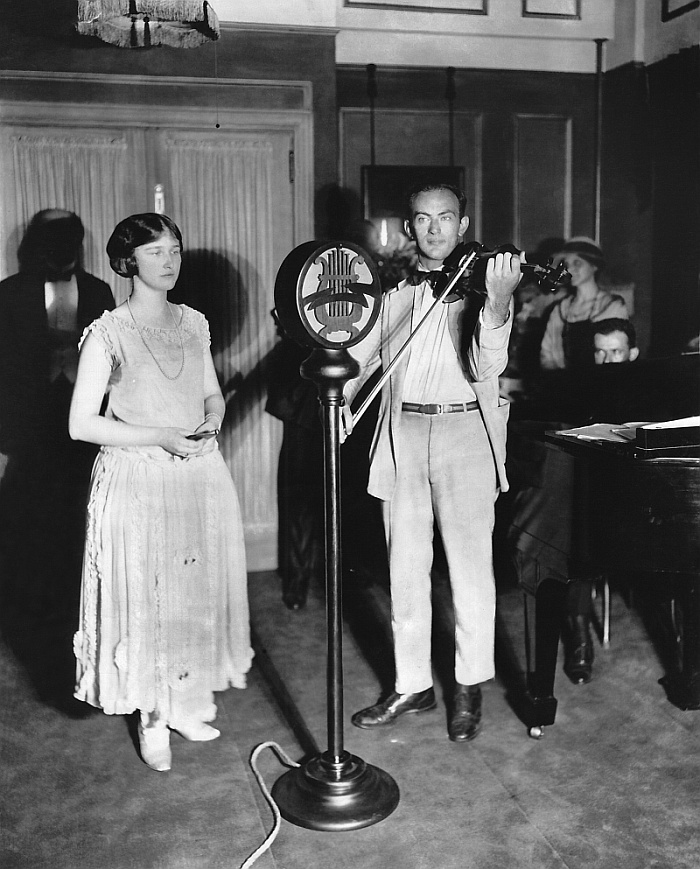
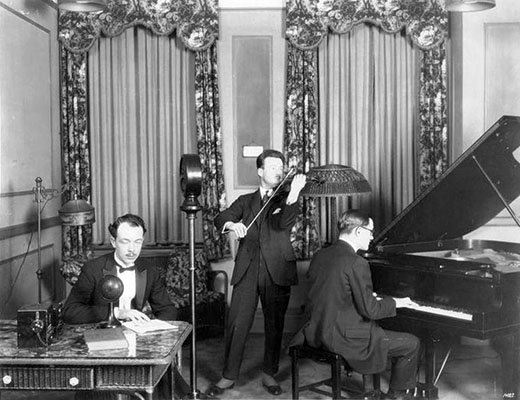
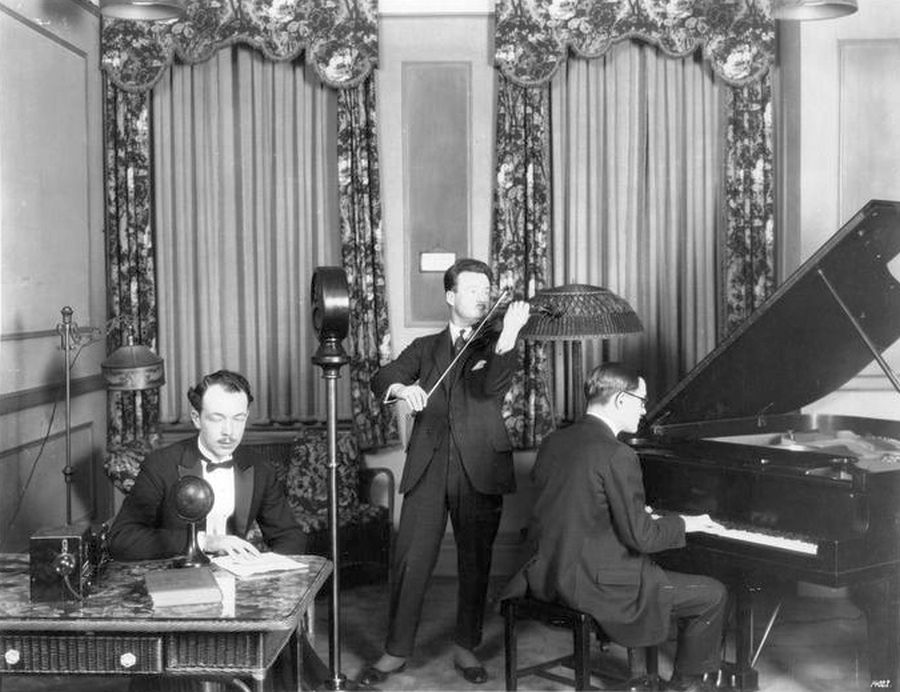
A broadcast from Aeolian Hall; photo credit
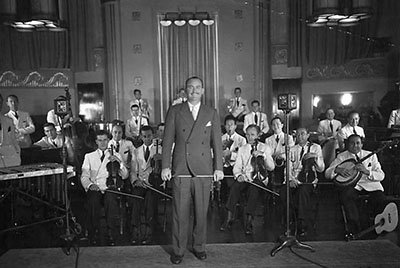
“Paul Whiteman and his orchestra in NBC studio B, 711 Fifth Avenue”; photo credit
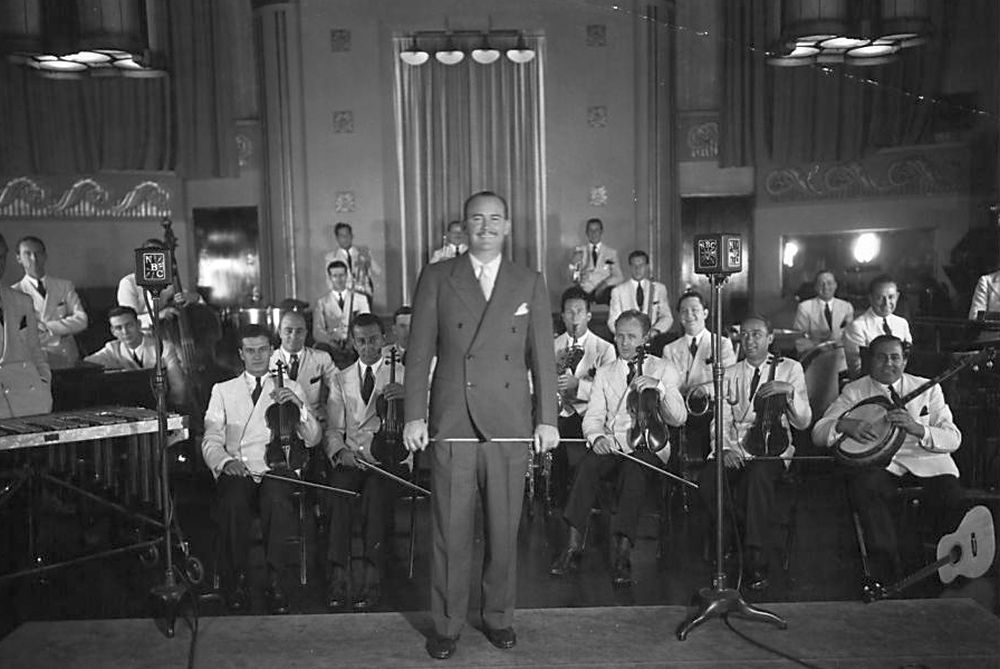
While it may have been a golden age of radio, it is hard to appreciate the radio programs and performers of the 1930s because we can listen to only a very few audio recordings of them, as "The great majority of pre-World War II live radio broadcasts are lost." (Wikipedia) In the absence of those recordings, it is difficult to piece together the actual work of the radio artists.
Hufsmith had committed to NBC radio in 1932, and in the years that followed he was a very active performer for the network. Yet, throughout the 1930s, as Hufsmith's career progressed in New York, he still sang often in Slatington and the Lehigh Valley.
There were several recitals in the First Presbyterian Church in Slatington. The church used to be on Main Street where the Mountain View Apartments are today.
For example, in February 1934, on a cold, wintry, Monday night, "nearly five hundred local music lovers crowded into the First Presbyterian church, Monday evening to welcome Muriel Wilson, Fred Hufsmith and Fern Sherman … The program was divided into two parts, the first, of a classical nature, while the second part included some of the lighter favorite numbers … Leading musicians of town have acclaimed this to the best musical program ever presented here." As a request, Hufsmith sang "The Old Refrain" in a manner "that held his audience spellbound." (You can listen to a 1939 radio broadcast version of the song by tenor Richard Crooks.) The recital concluded with "All through the Night," a traditional Welsh lullaby. (The Slatington News, 22 February 1934) (There are many versions of the song available online. This version is as good as any.)
The Morning Call agreed that "It was, indeed, the most outstanding musical treat in many seasons … Little did it matter whether it snowed and blowed (sic). As early as 7:30 the church was crowded to the doors and many were turned away. It was a sort of home-coming for Fred Hufsmith, one of the artists appearing on the programs. And the audience gave real expressions of their regard for their former townsman." (The Morning Call, 21 February 1934) There are available complete listings of the songs performed. (The Slatington News, 22 February 1934; The Morning Call, 19 February 1934)
Hufsmith also appeared in nearby Palmerton, PA.
On Sunday afternoon, 3 February 1935, Hufsmith sang with the Palmerton band in the high school auditorium as part of the band's annual winter concert. He sang several numbers including "Una furtiva lagrima" from Gaetano Donzinetti's opera L'Elisir d'amore and "I Love Life" by Mana-Zucca. (The Mana-Zucca song is rather short.) Newspaper coverage wrote that the annual Palmerton concert "will long be remembered as one of the best ever presented here … never before has this annual musical program attracted as large a crowd as was in attendance on Sunday. The high school auditorium, which seats 700, was inadequate and many stood along the sides." (The Morning Call, 2 and 5 February 1935) Hufsmith again appeared with the Palmerton band before a capacity crowd in November 1937. (The Morning Call, 5-6 December 1937)
It wasn't just singing engagements that brought Hufsmith to Palmerton. In October 1938 he was spotted on the golf course at the Blue Ridge County Club just north of Palmerton. (The Morning Call, 22 October 1938)
Hufsmith appeared in Allentown, PA.
On Thursday night, 15 October 1936, a large audience heard Fred Hufsmith and Muriel Wilson perform at the 19th St. Theatre in Allentown in conjunction with the motion picture, My American Wife. According to the newspaper, "More than 1700 persons heard Fred Hufsmith and Muriel Wilson, two of the National Broadcasting Company's best-known artists, in two concerts last night in the 19th St. Theatre." After each performed and "both responded with numerous encores," they "then appeared together and sang Verdi's famous "Parigi, o cara" [from La Traviata, ] and [Landon] Ronald's "O Lovely Night." (They were accompanied by Miss Fern Sherman (1899-1990) of New York city. (The Slatington News, 8 October 1936, The Morning Call, 16 October 1936)
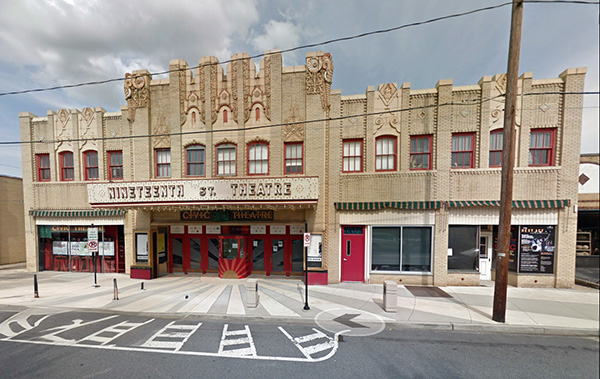
Recent photo of the Nineteenth St. Theatre in Allentown
And Hufsmith also continued to sing in Florida.
On Tuesday, 19 February 1935, "Radio Singers Get Applause at Music Club, Muriel Wilson and Fred Hufsmith Please Miami Audience" was the Miami headline. "Two fine singers who have made reputations as radio stars of the first magnitude were presented in a joint recital before a crowd that packed Mazica Hall yesterday at the meeting of the Mana-Zucca Music club." They jointly performed four operatic duets and then some individual numbers. Two of the duets were from La Traviata and Il Trovatore. (The Miami News, 20 February 1935)
Often radio listings in a newspaper were not that detailed. For example, you might see this in the paper:
7:30 – WEAF – Fred Hufsmith, tenor
Sometimes the program was an hour, sometimes half an hour, and sometimes as little as fifteen minutes. Sometimes Hufsmith was singing on station WJZ instead of WEAF; sometimes he was singing alone; sometimes with an orchestra; sometimes in a quartet or duo.
Occasionally, we can find a very few descriptive words about Hufsmith from a critic, for example:
- 3 April 1933, Daily News, "Harold Levey's orchestra, with June Pursell, Helen Nugent and Fred Hufsmith (WEAF – 245) filled the air with some of the day's best melodies."
- 18 July 1933, The Buffalo News, "Tenor Sub Makes Most of his chance, Fred Hufsmith Doing Good Job with Cavaliers in Place of Parker" by Joe Haeffner. "One of the better lyric tenors now on the air is Fred Hufsmith who is making the most of his greatest radio opportunity these Friday nights."
- 1 October 1934, The Jersey Journal, Hufsmith is "possessor of one of the finest tenor voices heard over the air – he sings each Monday night over WEAF."
- 3 June 1936, Daily News, "If it's a fine tenor you want, listen to Fred Hufsmith (WEAF – 7:30). He has a beautiful voice and sings with admirable ease."
Through much of the 1930s, Hufsmith often sang with Muriel Wilson (1901-1969), a soprano, who was born and raised in New York City. She starred on the Maxwell House Showboat program, aka Capt. Henry's Show Boat, which was the most popular radio program in the US between 1933 and 1935. Sunday, 19 April 1931 was the first mention that I could find of Fred singing together with Muriel Wilson on an evening show entitled "Old Stagers Memories."
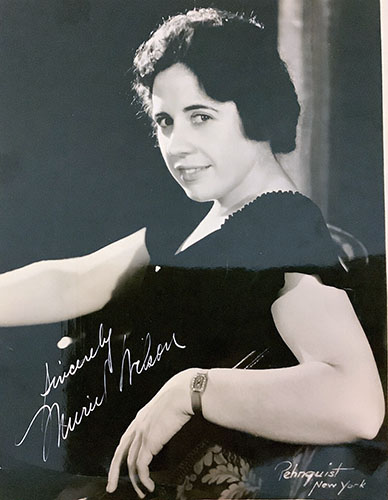
When I did a newspaper search to find mentions of "Fred Hufsmith" in the year 1933, I turned up over 2,500 matches, most of which were radio listings. Clearly by 1933 Hufsmith was a part of radio's golden age. It's a bit difficult to adequately identify the actual songs and music of his radio performances. Let me just list some examples of some of his radio appearances.
- Saturday 8 April 1933, the Sanford Orchestra with Alma Kitchell contralto, Muriel Wilson soprano, Fred Hufsmith tenor, John Barclay baritone
- Sunday 22 October 1933, Gems of Melody program with Muriel Wilson soprano, Fred Hufsmith tenor, Harold Sanford's orchestra
- Sunday, 1 April 1934, Gems of Melody program with Harold Sanford's orchestra, Muriel Wilson soprano, Fred Hufsmith tenor. This is one of the rare occasions where we have a listing of some specific songs. Hufsmith sang "Hosanna" by Grainer (Théodore Dubois); Wilson sang the "Butterfly Waltz" by [Victor] Herbert; then the duet sang "Easter Parade" by Irving Berlin. (That song was later made famous by Judy Garland and Fred Astaire in the 1948 musical of the same name.)
- Sunday 8 April 1934, Gems of Melody program. Here we also have some specific song information. Hufsmith sang "Ah Sweet Mystery of Life." (Here's a recording of Bing Crosby singing the song from 1939.); Hufsmith and Wilson sang "Eileen Asthor." (Here's one version.)
- Monday, 20 August 1934, Firestone Garden Concert with Gladys Swarthout mezzosoprano, Margaret Speaks soprano, Fred Hufsmith tenor, Frank Chapman baritone and William Daly's symphonic string orchestra
- Thursday, 5 December 1935, Babes in Toyland, Victor Herbert's musical comedy with Harold Sanford's orchestra, Alma Kitchell contralto, Ivy Scott and Muriel Wilson sopranos, Fred Hufsmith tenor
- Saturday, 7 March 1936, The Melody Lingers On program, Leo Spitalny's orchestra with Robert Weede and Fred Hufsmith
- Tuesday, 13 April 1937, Hammerstein's Music Hall with Fred Hufsmith and Louise D'Angelo
- Tuesday, 11 May 1937, Operatic Gems program with Tom Thomas, Christine Johnson, Fred Hufsmith and Louise Flores
- Sunday, 22 August 1937, The Headless Horseman (operetta) with Edward Wolter baritone as Ichabod Crane, Muriel Wilson soprano as Katrina Van Tassel, Fred Hufsmith tenor as Brom Bones and Earl Styres as Cornnelius Van Tassel.
Among some of the most popular music on the radio in the 1930s was the work of Gilbert and Sullivan. W. S. Gilbert (1836-1911) and Arthur Sullivan (1842-1900) were a prolific musical duo that produced fourteen comic operas including The Pirates of Penzance and The Mikado. These light operas were very popular in the 1930s, and they continue to be performed today. In the 1930s, both Hufsmith and Wilson were often singing Gilbert and Sullivan numbers. For example,
- 1 April 1933, 10-1030 AM on station WJZ, the program "Gilbert and Sullivan Gems" included selections from various Gilbert and Sullivan operas with both Muriel Wilson and Fred Hufsmith performing.
- 10 June 1933, Wilson and Hufsmith were part of the program "Selections from Gilbert and Sullivan" with Harold Sanford's orchestra.
- 2 January 1935, NBC announced that Gilbert and Sullivan operettas were to be broadcast weekly in an hour-long format with Harold Sanford's orchestra, Wilson and Hufsmith, beginning with H.M.S. Pinafore and followed by The Pirates of Penzance.
- 17 April 1936, the broadcast of Gilbert and Sullivan's Yeoman of the Guard with Hufsmith as Colonel Fairfax and Wilson as Elsie.
Hufsmith Publicity
As his career rose, occasionally, newspaper articles would appear that provided some biographical information about Hufsmith.
For example, he was described as a "young man who got his start musically in Lehigh County and since has risen to fame in the radio and concert world … He appeared in various high school presentations but received his actual baptism before the footlights with the Premiere Musical Club of Slatington, an organization that is still in existence." (The Morning Call, 13 October 1936)
And another, longer article provided some more information. Hufsmith is "possessor of one of the finest tenor voices heard over the air – he sings each Monday night over WEAF on the tire programs with Gladys Swarthout." (Swarthout, 1900-1969, was an opera singer with the New York Metropolitan Opera Company from 1929 to 1945.) He left Slatington at age nineteen to become soloist at a church in Bethlehem, PA. He later became a member of the Conley Concert Company in Philadelphia, sang in several Philadelphia churches and eventually joined the Swarthmore Chautauqua Association. In 1928 he turned up in New York, and after passing an audition with NBC, Hufsmith was hired by the network. "His first NBC work was as a member of the long popular Armchair Quarter," which was a popular vocal group through the 1930s on NBC.
Allegedly, he was 5' 4 ½", 138 pounds with brown hair and brown eyes ("Last Night with the One Dialer," The Jersey Journal, 1 October 1934)
That same article noted that in the Sunday, 30 September 1934, Star Dust program, Hufsmith sang "Memory Lane," which was the signature song for the Voice of Firestone program which ran on NBC from 1928 to 1956 and which was sponsored by the Firestone Tire and Rubber Company. (Here's one version of the song from 1924.) He also sang the old, nineteenth-century ballad, "I'll Take You Home again Kathleen." (The Sons of the Pioneers sang this song, and they also sang the song in a memorable scene in John Ford's classic 1950 movie, Rio Grande. In the scene, the regimental singers serenade Maureen O'Hara and John Wayne.)
Marriage to Muriel Wilson
The Morning Call ran with the headline, "Fred Hufsmith, NBC Star of Slatington Weds Muriel Wilson, Also Radio Artist." (30 January 1938) This was the culmination of a years-long courtship.
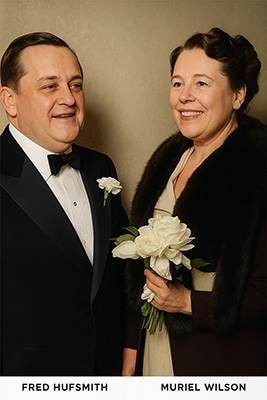
Photo credit: The Morning Call, 16 February 1950; photo AI restored
The two radio artists met sometime in 1931. One account from 1934 noted "that they met three years ago at a Hymn Sing program in the studios [of NBC]." (The Brooklyn Eagle, 5 December 1934) The earliest instance that I could find any mention of the two of them singing together on the radio was Sunday, 19 April 1931 at 7 PM in a program entitled "Old Stagers Memories." (The Brooklyn Eagle, 19 April 1931)
Through the 1930s, Fred and Muriel often sang together both on the radio and at in-person recitals. For example, in October 1932 they sang in the premiere of Charles Wakefield Cadman's opera The Willow Tree, a one-act opera written to be performed on radio. (Daily News, 3 October 1932) On 19 February 1934, in front of a large audience estimated at almost five hundred persons, they performed in Slatington's First Presbyterian Church in a recital sponsored by that church's Young Ladies Sunday School Class. (The Slatington News, 22 February 1934)
In December 1934, rumors began to circulate that Fred and Muriel were engaged.
Last Night with The ‘One Dialer', the gossip columnist, reported that "one of our contemporaries over in the big City … scored ‘a beat' yesterday when he wrote about Muriel Wilson and Fred Hufsmith as sweethearts soon to wed." (The Jersey Journal, 5 December 1934) The Brooklyn Eagle also wrote of "upcoming wedding bells" for the couple (5 December 1934), and The Buffalo News added "When Miss Wilson appeared in the studios wearing a diamond solitaire the news was out." Allegedly, "on Thanksgiving Day, [the couple] announced the engagement at a dinner attended by both families." (The Buffalo News, 8 December 1934)
There might have been some intrigue surrounding the romance. "These two persons [Fred and Muriel] were the central figures of an almost tragic romance due to the position Miss Wilson occupied on the Showboat [radio program]. She was singing opposite Lanny Ross and for publicity reasons, was barred from announcing either an engagement or marriage. This was due in great part to the fact that the public had built up a romance between Mary Lou and Lanny Ross. However, not so long ago, Mary Lou decided that a career was not worth all the sacrifices and heartaches required of her, and so, in June, or thereabouts, Mr. and Mrs. Fred Hufsmith will be open for congratulations." (The Slatington News, 4 April 1935)
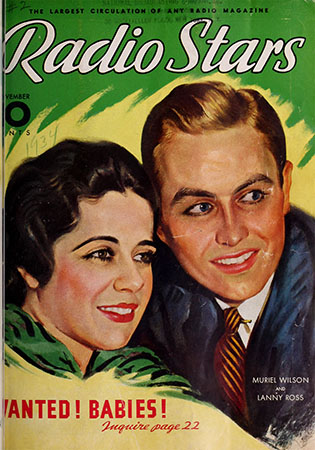
Here's the cover of Radio Stars magazine, November 1934.
Lanny Ross (1906-1988) was one of the stars on the Maxwell House Showboat program, aka Capt. Henry's Show Boat. The variety program which aired Thursday nights at 9 on NBC radio was very loosely inspired by the Edna Ferber book Show Boat and the Jerome Kern 1927 musical of the same name. Between 1933 and 1935, the "Showboat" program was the most popular radio program in the US.
In a publicity article "written" for Radio Stars, Muriel wrote about visiting Lanny Ross in Hollywood where Ross was pursuing a movie career at the time. "You know, of course, that Mary Lou and Lanny on the Show Boat hour are in love on the air." That fiction was maintained despite the fact that each of them was engaged by the time the article appeared in November 1934. Also, in the article, Muriel wrote about dinner, dancing and spending time on the beach in Hollywood.
After a long courtship, the wedding between Muriel and Fred finally took place on Friday afternoon, 28 January 1938, in the Faith Presbyterian Church (359 West 48th Street) in New York City with the immediate families in attendance. Edward Kraus of Slatington was the best man. The reception was held at 850 7th Ave., the couple's future home. That address is near Central Park and close to Carnegie Hall. It was a rather prestigious location befitting their radio celebrity status. (The Morning Call, 30 January 1938)
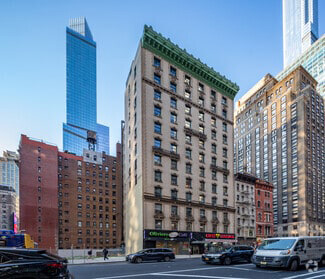
The building at 850 7th Avenue, built 1910, is now a 12-story office building.
The Wilson family
Muriel Wilson was born and grew up in New York City. Including Muriel, there were five in the Wilson family.
(father) William Henry Wilson (1873-1939) owned a dry goods store in Manhattan.
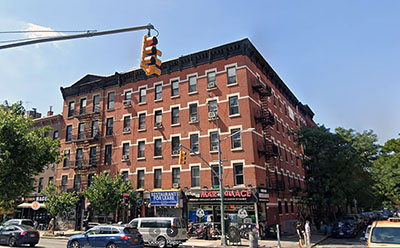
Site of the Wilson dry goods store, corner of 9th Ave. and W. 48th St. in West Manhattan; photo credit: Google maps
(mother) In 1898 in Union City, NJ, William married Nellie Savidge (1877?-1950). She was an active suffragette and later a republican party leader in New York City.
(brother) Willard Gordon Wilson (1902-1971) was a career banker with the Bank of New York, now the Bank of New York Mellon Corporation.
(brother) Donald Stanley Wilson (1905-1998) lived in New York and then Massachusetts.
(sister) Muriel Helen Wilson (1901-1969).
How did she get started on a radio career?
By the early 1920s, I found quite a bit of evidence that Muriel was singing in churches across New York city. Muriel "owed her success in the radio field to a chance offered her by Milton Cross" (1897-1975). Cross was a prominent NBC radio announcer and the announcer for the Metropolitan Opera's Saturday afternoon radio concerts. Somehow, he became aware of Muriel's singing and "asked her to sing on an NBC announcers' program." That was the break that she needed. (The Morning Call, 12 February 1950)
The first time I saw her listed on a radio program was 15 March 1923, when she was scheduled on station WJZ for a recital from 845 to 915 PM on a Thursday night. Her mother was her accompanist. In the months that followed, there were other radio appearances, usually on station WEAF.
By 1927, she was on the radio all the time and was gathering some notice. "One of the sweetest clearest, truest soprano voices we have heard in many months is that of Muriel Wilson, whose recital at WOR, assisted by a string trio, was delightful. Miss Wilson has the real gift of musical expression. She knows what she is singing about and conveys that knowledge to her hearers as few radio singers do. In the pretty little number, "Bon Jour, Ma Belle," she was arch (sic) without being ridiculous, and gave just the right touch of coquetry to the cleverly written lines. A song like this is absolutely no good if the singer mouths the lines like a town crier, and that is why Miss Wilson's rendition was so superior. As for the letter "r," she did fuller justice to it than any singer we have heard in a long time." (Brooklyn Eagle, 12 November 1927)
By 1928 and 1929 she was consistently on the radio. Then at the start of 1933 she was added to the "Show Boat" cast.
"Capt. Henry's Show Boat adds another celebrity to its bright cargo of stars as Muriel Wilson, well-known for her distinguished work in opera and radio for the last five years, joins to large cast as the soprano sweetheart of Lanny Ross, the show boat's star tenor. Miss Wilson, known along radio row as ‘Duchess' and ‘Bright Eyes', has been featured on eight national programs in the last five years, and in addition sang in the National Light Opera company for five years. Previous to her radio and operatic engagements she acquired considerable experience in concert tours through New England, in vaudeville and musicales. She began her musical career by singing in an amateur theatrical at the age of three."
"Born in New York city of English-Irish parentage, she is 5 feet 4 inches tall, has fair complexion and brown hair." (The Buffalo News, 31 December 1932)
Hufsmith's Radio Career in the 1940s
In 1942, Hufsmith was forty-five years old, and on his military registration card, he listed his address as 850 Seventh Ave, New York and his employer as NBC, Rockefeller Center. As a physical description, he noted that he had a light complexion, was 5'4" and 160 lbs. with brown eyes and gray hair.
It became harder to track Hufsmith's radio work in the 1940s, as newspapers were no longer printing detailed radio schedules. For example, when searching for mentions of Hufsmith in 1944 newspapers, I found only 100 matches. Compare that to the 2,500 matches that I found for 1933 newspapers. The lack of newspaper coverage makes it harder to determine the extent of his radio performances for NBC.
But, Hufsmith was still appearing at events in Slatington.
For example, at the end of February 1940, Hufsmith attended the American Legion minstrel show held in the high school auditorium in Slatington. He had been part of the earliest minstrel shows in Slatington in 1915 and 1916, and at this show in 1940 the newspaper reported that "many very pleasant memories were brought back when the 'old-timers' sang their numbers and 'did their stuff'." Hufsmith, regarded as "Slatington's native son," sang several solo numbers, including "Meet Me Tonight in Dreamland." (Here's a 1959 version of the song by Bing Crosby.) As an encore Hufsmith sang "The Old Refrain." (The Slatington News, 29 February 1940, The Morning Call, 1 March 1940)
A few years later, Hufsmith appeared as a guest soloist at Pennsylvania Week celebrations in Slatington. The main event took place in Smith Hall on Wednesday evening, 29 September 1948. Hufsmith sang, accompanied by Edward Hausman on piano, as part of a program honoring Dr. Mark Everett (1899-1981), a 1916 graduate of Slatington High School and Dean of the University of Oklahoma School of Medicine. "Fred Hufsmith, well known tenor soloist of New York, also a former resident of town, received a warm welcome" from the crowd of over one thousand. He sang "Dawn's Treasure," "Casey the Fiddler," "The Old Refrain" and "The Neapolitan Love Song." (I am not exactly sure of the exact title of that last song, but here is a version sung by Mario Lanza.) (The Slatington News, 23 and 30 September 1948; The Morning Call, 22, 28 and 29 September 1948)
Then, in the following year, both Fred and Muriel Hufsmith turned up in Slatington to sing at a benefit concert hosted by the mission club of the Presbyterian Church. The recital was held in the high school auditorium on Monday, 14 March 1949 at 815 PM, as the church was not big enough to handle the capacity audience. The concert opened with a duet of "My Song Shall Be Always Thy Mercy" by Felix Mendelssohn. (Here's an example of that song.) Fred Hufsmith sang quite a few numbers that evening, including "A Wandering Minstrel I" from the Gilbert and Sullivan opera, The Mikado. (Here's a version of that song.) Edward Hausman, the pianist for the evening, also played several works including Frédéric Chopin's Fantaisie-Impromptu in C Sharp Minor Op. 66, (Here's Danil Trifonov playing that work.) (The Slatington News, 17 February and 10 March 1949; The Morning Call, 10 March 1949)
And Hufsmith was still appearing on the radio.
For example, on Sunday, 7 April 1940, Hufsmith took part in a Reginald de Koven birthday anniversary concert that took place from the music room of the composer's mansion on Park Avenue. The broadcast on station WJZ took place between 8 and 9 in the evening. The performance involved Frank Black, director of the NBC concert orchestra and chorus, Rose Dirman (1900-1975), a lyric soprano from New Orleans, Hufsmith, and Thomas (Tom) Thomas (1911-1983), a popular Welsh baritone. The group sang numerous songs by Reginald De Koven (1859-1920), a prolific composer of twenty light operas and hundreds of other works. Coverage of the program noted that "A beautiful and deserved tribute to the memory of a fine American composer, Reginald De Koven, was paid by a group of artists, directed by Frank Black, in the music room of the De Koven mansion on Park Avenue." They "sang as if inspired." (Daily News, 8 April 1940)
I found Hufsmith singing on the radio in several different programs featuring Gilbert and Sullivan operas through the 1940s.
- February 1941, Hufsmith appeared in the cast of Gilbert and Sullivan's The Mikado, which was being broadcast on WIOD, a station that was part of the red network of NBC radio. "The cast will be topped by Fred Hufsmith, for several years an NBC artist who started his musical studies here at the University of Miami." (The Miami News, 2 February 1941)
- March 1943, Hufsmith sang the role of Ralph Rackstraw in the Gilbert and Sullivan H.M.S. Pinafore on the NBC radio network. (The Miami News, 13 March 1943)
- August 1944, the seven-week, Saturday-evening, hour-long program of Gilbert and Sullivan operettas broadcast on WJZ featured Hufsmith. The series began with a performance of H.M.S. Pinafore. "An excellent cast, which included the radio opera and operetta veteran Fred Hufsmith made the hour pass all too soon." (The Evening Sun (Hanover, PA), 19 August 1944; The Jersey Journal, 22 August 1944)
- August 1945, Hufsmith was part of the seven-week Gilbert and Sullivan Festival that was broadcast on ABC radio on Saturday nights at 830 PM. (Buffalo Courier Express, 18 August 1945)
Still, as radio changed from live to recorded music through the 1940s and as television programs began to be broadcast, it seems like the Hufsmiths had less of a radio presence. Indeed, the "One Dialer" wondered, "Whatever became of … Muriel Wilson and Fred Hufsmith … all of whom had excellent voices and contributed much to radio listening pleasure in past days." (Listening in with ‘One Dialer", The Jersey Journal, 6 February 1947)
Later Radio Career 1950s-60s
By the 1950s, radio broadcasting had changed dramatically from the live performances of the 1930s. I could not find any real indication of how active either Fred or Muriel Hufsmith might have been on radio broadcasts at the time, but they were still singing. And occasionally, they would appear in the Lehigh Valley.
For example, in February 1950 the Hufsmiths and Edward Hausman gave a recital at St. Michaels Lutheran Church, 9th and Turner Streets in Allentown, PA. The Morning Call covered the concert and reported that the artists "Offered an interestingly varied program of sacred and secular music that displayed their talented voices excellently in solo and duet last night in St. Michael's Lutheran church." They started the evening with duet version of Felix Mendelssohn's "My Song Shall Always Be Thy Mercy," which is a song taken from his Symphony No. 2. Then, Fred and Muriel each sang a set of solo numbers, followed by Hausman playing a trio of songs by Robert Schumann transcribed for piano by Franz Liszt. The Hufsmiths finished with a series of duets beginning with the famed garden scene from the opera Faust by Charles Gounod and then the song "I'll See You Again" from Noël Coward's operetta Bitter Sweet, (The Slatington News, 9 February 1950; The Morning Call, 16 February 1950)
In October 1953, the Hufsmiths again sang in the old Slatington High School auditorium, and again sponsored by the mission club of the First Presbyterian Church. They performed "a varied selection of music" and started the evening with four duet numbers beginning with the Christian hymn, "Love Divine." After pianist Ruth Branch of New York played several numbers, Muriel and Fred each sang a series of solo numbers. They concluded the evening's program with several duets, including two from Gilbert and Sullivan operettas.
- "Stay, Frederic Stay," duet from The Pirates of Penzance (Here's an example.)
- "Were You Not to Ko-Ko Plighted?," duet from The Mikado (Here's an example.)
(The Slatington News, 17 September, 15 and 22 October 1953; The Morning Call, 21 October 1953)
But appearances in Slatington grew rarer.
Slatington Centennial 1964
I was not able to find any performances listed in any newspaper in Pennsylvania, New York, New Jersey or Florida by the 1960s. I'm sure both Fred and Muriel were still singing, but it was no longer on the radio or on any commercial stage.
Fred Hufsmith's August 1964 appearance as part of the centennial festival in Slatington was probably his last visit to the town. And as I noted in the introduction of the centennial, "he sang the beautiful 'Serenade' and the nostalgic 'Hills of Home'." (The Morning Call, 29 August 1964) Have a listen, again, to Mario Lanza singing the "Hills of Home."
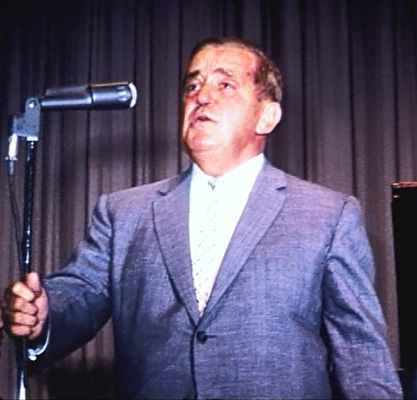
Photo credit: The 1964 Centennial Celebrating 100 Years of Slatington History DVD
Death
Fred and his wife Muriel died a year apart. She died in May 1969 at age 67, and he died in May of the following year at age 73. They were living in Yonkers, NY at the time, having moved there in about 1963. A short obituary for her appeared in The Herald Statesman (Yonkers), while only a shorter death notice appeared for him in the same newspaper. They had no children.
It goes without saying that both had marvelous singing careers; both were stars in radio's golden age; both had made it to the top pf national airwaves; and both were skilled performers in person and on live broadcast radio.
Fred himself seems to have never forgotten his roots growing up in Slatington, as he repeatedly returned to his home town over the years to perform.
Singing style
Hufsmith was often labeled as a "lyric tenor."
Here are two available, rather technical definitions.
"The lyric tenor is a warm graceful voice with a bright, full timbre that is strong but not heavy and can be heard over an orchestra. Lyric tenors have a range from approximately the C one octave below middle C (C3) to the D one octave above middle C (D5)." (Wikipedia)
"Lyric tenors have a range from approximately the C one octave below middle C (C3) to the D one octave above middle C (D5) " (Classiccat)
Here are some famed lyric tenors that you might have heard of.
- Enrico Caruso (1873-1921), especially in his early years
- "The Three Tenors": Luciano Pavarotti (1935-2007), Plácido Domingo (1941-) and José Carreras (1946-)
How to listen to Hufsmith
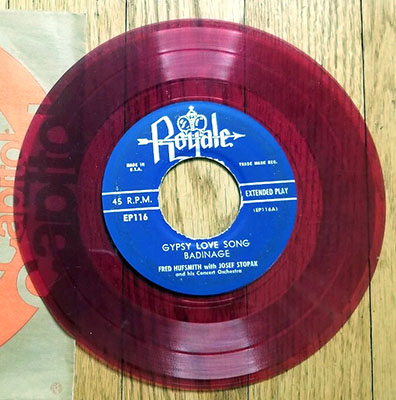
Fred Hufsmith, “Gypsy Love Song,” Royale, circa 1948
There are just a few recordings featuring Fred Hufsmith on YouTube, such as
- Fred Hufsmith with Lew White (organ) – "I'll Take You Home Again, Kathleen," 1941
- Fred Hufsmith with Lew White (organ) – "Just Awearyin' for You," 1941
- Fred Hufsmith and Walter Preston – Gilbert and Sullivan's H.M.S. Pinafore, 1942
- Fred Hufsmith & Joseph Stopak Concert Orchestra – "Greensleeves Concert" - Starlight Starbright
Discogs has a listing of four records involving Hufsmith.
Occasionally, old Hufsmith 45 ep records pop up on eBay, such as this recording of "Starlight Starbright."
Archive.org also has some songs that you can listen to that feature Hufsmith.
I'm not sure any of these recordings do actual justice to his talent.